Posted on March 06, 2026
Why I Built MuseMVP: Reflections on Shipping Faster
Reflections on shipping MVPs faster. MuseMVP provides a stable, reusable engineering foundation designed for rapid launches and AI collaboration.
The Starting Point: A Very Specific Kind of Fatigue
If you ask me how MuseMVP started, I probably wouldn’t begin with a grand vision or a tech stack.
I would start with a very specific kind of fatigue.
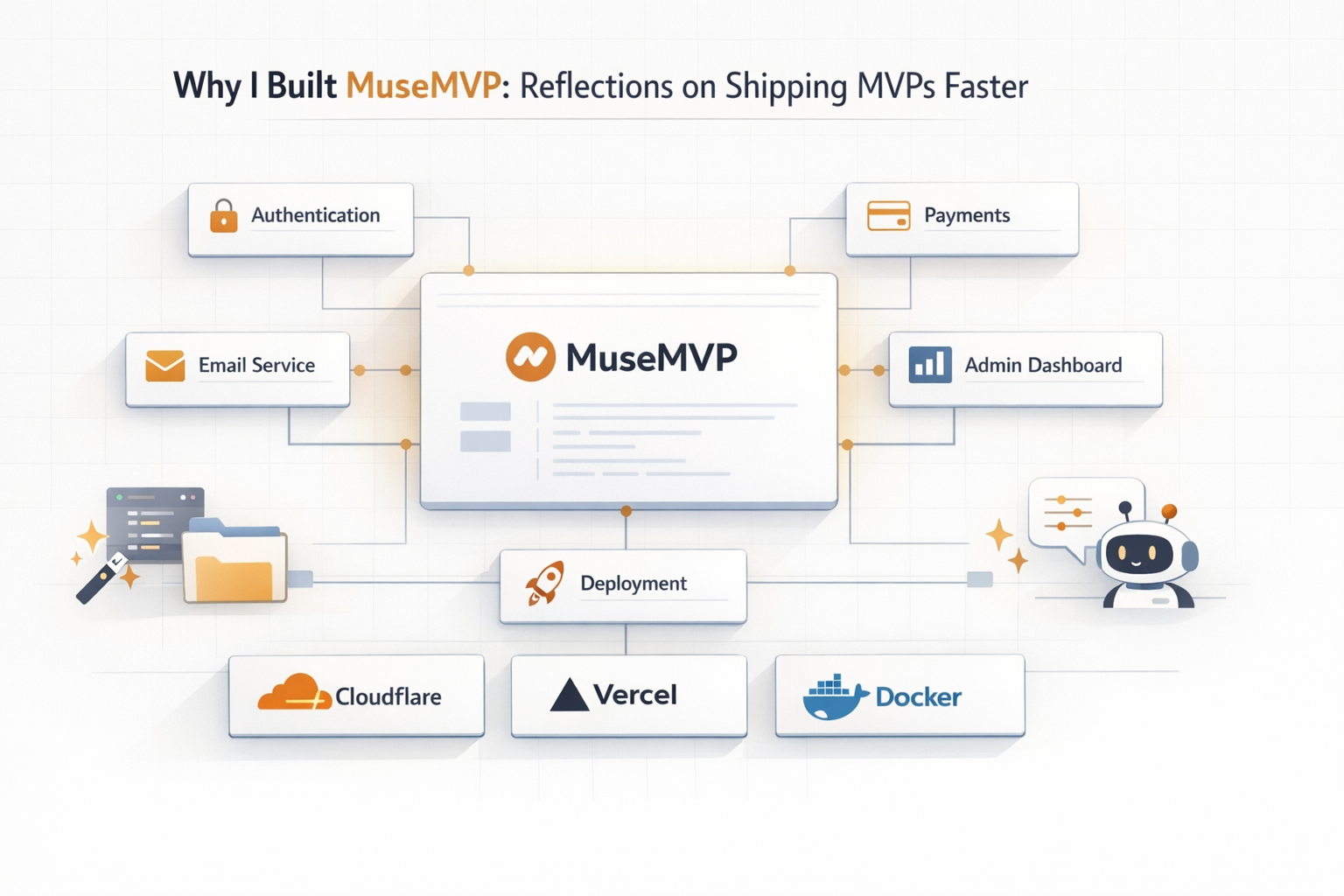
Every time I wanted to build a new product, the core idea was already clear. But I still had to go through the same cycle again and again: authentication, permissions, payments, email systems, admin dashboards, deployment.
All the things that are necessary, but don’t really create user value.
You end up writing code every day, but somehow you’re not getting much closer to actually launching.
I’ve been through this loop many times. At the beginning of a project, everything feels exciting. The roadmap is written down, the repository is created, and you feel like this time things will move faster.
But slowly the rhythm changes.
First you wire up the basic infrastructure. Then you deal with edge cases. Then come environment differences, build issues, runtime problems. And when you look back, the most valuable two or three weeks were often spent not on user value, but on assembling the engineering foundation.
At some point I realized something important: independent developers and small teams usually don’t lack coding ability. What they lack is the ability to ship reliably.
Plenty of people can write code. Far fewer can continuously push products online and iterate based on real feedback. The former is a technical problem. The latter is a systems problem.
MuseMVP is essentially my attempt to build a shipping system, not just a code template.
After Building Enough Projects, You Start Seeing Patterns
Once you’ve built several web applications, something interesting starts to appear.
On the surface, every product looks completely different. Different business logic, different interfaces, different audiences.
But if you peel away those differences, a lot of the underlying pieces are surprisingly similar.
Almost every product ends up needing the same kinds of foundations:
- user authentication
- permission systems
- payments and subscriptions
- email notifications
- admin dashboards
- deployment environments
These parts rarely create direct user value, but every product needs them.
After repeating this process enough times, you begin to realize something simple:
A large portion of this logic can be reused, abstracted, and stabilized.
The most expensive thing in software development isn’t code.
It’s repetition.
The real challenge isn’t whether these pieces exist. The challenge is organizing them into a structure that can evolve over time and remain maintainable across different projects.
Part of the motivation behind MuseMVP comes from this realization. Instead of rebuilding these foundations from scratch every time, it makes more sense to consolidate them into a stable engineering base that new projects can start from.
Two Problems That Kept Appearing
Looking back at past projects, two problems kept appearing over and over again. These eventually became key design considerations for MuseMVP.
Uncertainty in Deployment Paths
Many projects run perfectly on a local machine. But once you move into real production environments, problems begin to appear.
Differences between platforms quickly surface: dependency versions, runtime environments, configuration setups, build pipelines. Each of these can introduce unexpected friction.
You think you’re moving the product forward, but in reality much of your time goes into solving infrastructure issues.
The product rhythm gets dragged backward by engineering complexity.
Because of this, the first design goal of MuseMVP wasn’t about writing elegant code. It was about answering a more practical question:
Can the same codebase remain stable, maintainable, and predictable across different production environments?
Cloudflare Workers, Vercel, and Docker aren’t just marketing options here. They represent real engineering constraints. The goal is to give developers flexibility to choose deployment paths depending on their stage and needs, without locking them into a single platform because of structural limitations.
What Happens After the Project Starts
Another very real problem appears after the project begins.
Many tools essentially reach the end of their lifecycle the moment they are delivered. You receive a starting codebase, but the difficult part is figuring out what to do next week.
How do you prioritize features? How do you interpret user feedback? Where does the first growth effort begin? Which experiments are worth trying first?
These questions often determine whether a project survives.
This is why MuseMVP emphasizes continuously updated docs and community collaboration. It’s not intended to be static documentation, but a living field guide.
It captures decisions developers actually face while building products and turns vague uncertainty into concrete next steps.
The Shift in the Age of AI Vibe Coding
Another major change has emerged in recent years: more and more code is no longer written entirely by humans.
Instead, it’s created in collaboration with AI.
Many developers now rely on AI tools for what people often call vibe coding — describing intent, generating implementations, and iterating through conversation.
In this workflow, something interesting happens.
Much of the code inside a project is no longer primarily written for humans.
It’s written for AI to understand.
Developers increasingly focus on describing intent, guiding direction, and reviewing outputs, while AI handles a large portion of the implementation.
This makes project structure far more important than before.
If a codebase is disorganized, unclear, or inconsistent, AI struggles to understand it and extend it reliably.
MuseMVP was designed with this reality in mind.
The project structure, directory organization, rule files, and engineering constraints are all built around a simple idea: make the codebase as easy as possible for AI to understand.
When AI can clearly understand a project’s structure, it becomes much more reliable at generating features, fixing bugs, and performing refactors.
In that sense, MuseMVP isn’t just an engineering foundation for developers.
It’s also an engineering foundation designed for AI collaboration.
The Real Value: Not More Features, But Better Rhythm
As I built more products, I found myself talking less about feature counts.
For people who actually build products, the number of features rarely determines success.
What matters far more is whether you can make the right decisions at the right time.
You don’t need an overwhelming checklist of capabilities. You need a rhythm that keeps the project moving forward.
The goal of MuseMVP is simple: reduce repetitive work as much as possible, and move the meaningful actions earlier in the process.
Ideally, the experience should look something like this:
On the first day, you can put the project online so real users can access it — not just run it locally.
After that, your time should focus on understanding users, improving the product, and making decisions based on feedback, rather than continuously rebuilding infrastructure.
Closing Thoughts
For me, MuseMVP is essentially a reflection on years of building web products.
The mistakes I repeated eventually turned into reusable structures. The detours I took gradually became a more stable engineering approach.
The goal isn’t to create something technically impressive. It’s to remove as much unnecessary friction from the development process as possible, so people building real products can focus on what actually matters.
If MuseMVP can help a project go online in a single day, make collaboration with AI easier, and allow developers to spend more time on users and product decisions, then that alone makes it worthwhile.